Teaching
How Learning Happens
Teaching relies on knowledge of student learning. It is helpful to consider the Simple Model of Memory by Daniel Willingham to understand how learning happens.
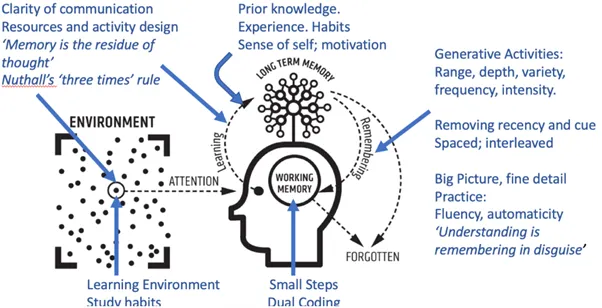
This model tells is that learning is a persistent change in long term memory, driven by what we think about. The model consists of three main components:
- Working memory – conscious thought/ limited in capacity
- Long term memory – a vast storage system for knowledge and schema
- The environment – the conditions where learning takes place
Willingham tells us that “memory is the residue of thought” which means that thinking and focusing on something is what helps us learn and remember it.
Students have a lot of prior knowledge, but they might not remember it if they haven’t recalled it from their long-term memory for a while. This is why retrieval practice is such an important part of what we ask students to do in lessons. We ask them to recall knowledge regularly so that they can bring it into their short-term memory whenever it is needed.
Spaced and Interleaved Practice
Our curriculums include spaced and interleaved practice to support recall of knowledge. This is to avoid students forgetting what they have learned over time.
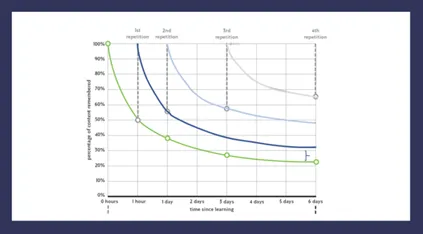
German Psychologist Hermann Ebbinghaus introduced the concept of the forgetting curve, based on the following ideas:
- as soon as you achieve some understanding of an idea, you begin forgetting it almost immediately.
- the rate of forgetting is often shockingly high; a few hours after learning something, people routinely remember only a small fraction of it.
- each time you practice recalling what you know, the rate and amount of forgetting is reduced somewhat.
- retrieving something back into working memory slows the rate of forgetting, but how and when the retrieval happens is important.
The WVA Learning Cycle
At Weldon Village Academy, we plan lessons that our engaging and inclusive. Our learning model follows a cyclical structure, but the phases are not bound to a single lesson. While some lessons will involve introducing new content or retrieving knowledge from prior learning, others focus on students working independently.
.webp)
Ultimately, we want students to be independent and help them to apply their skills in a range of increasingly complex scenarios.
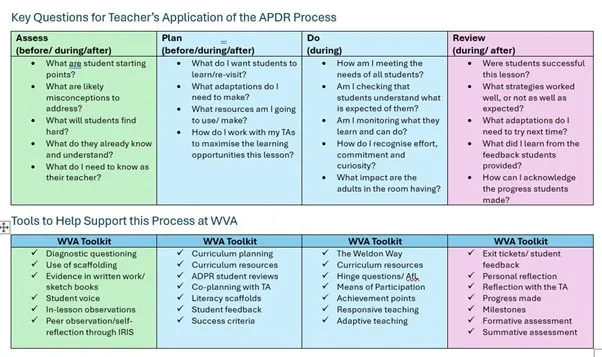
Assess, Plan, Do, Review
The APDR process sits at the very heart of our approach to teaching and learning. At every stage of a lesson, a teacher should be asking themselves the following questions to ensure effective and inclusive teaching: